
Electronic Signatures: Revolutionizing Tenant Screening for Landlords in 2026
In today’s fast-paced rental market, landlords and property managers face increasing pressure to fill vacancies quickly while minimizing risks. Electronic signatures (e-signatures) have emerged as a game-changing tool, allowing seamless collection of tenant consent for credit and background checks. This comprehensive guide explores how e-signatures streamline the tenant screening process, ensure FCRA compliance, and help avoid common pitfalls like locked credit files.
By integrating e-signatures into your rental application, you can accelerate approvals, reduce paperwork, and make more informed decisions.

FCRA Compliance: The Critical Role of Signed Authorization
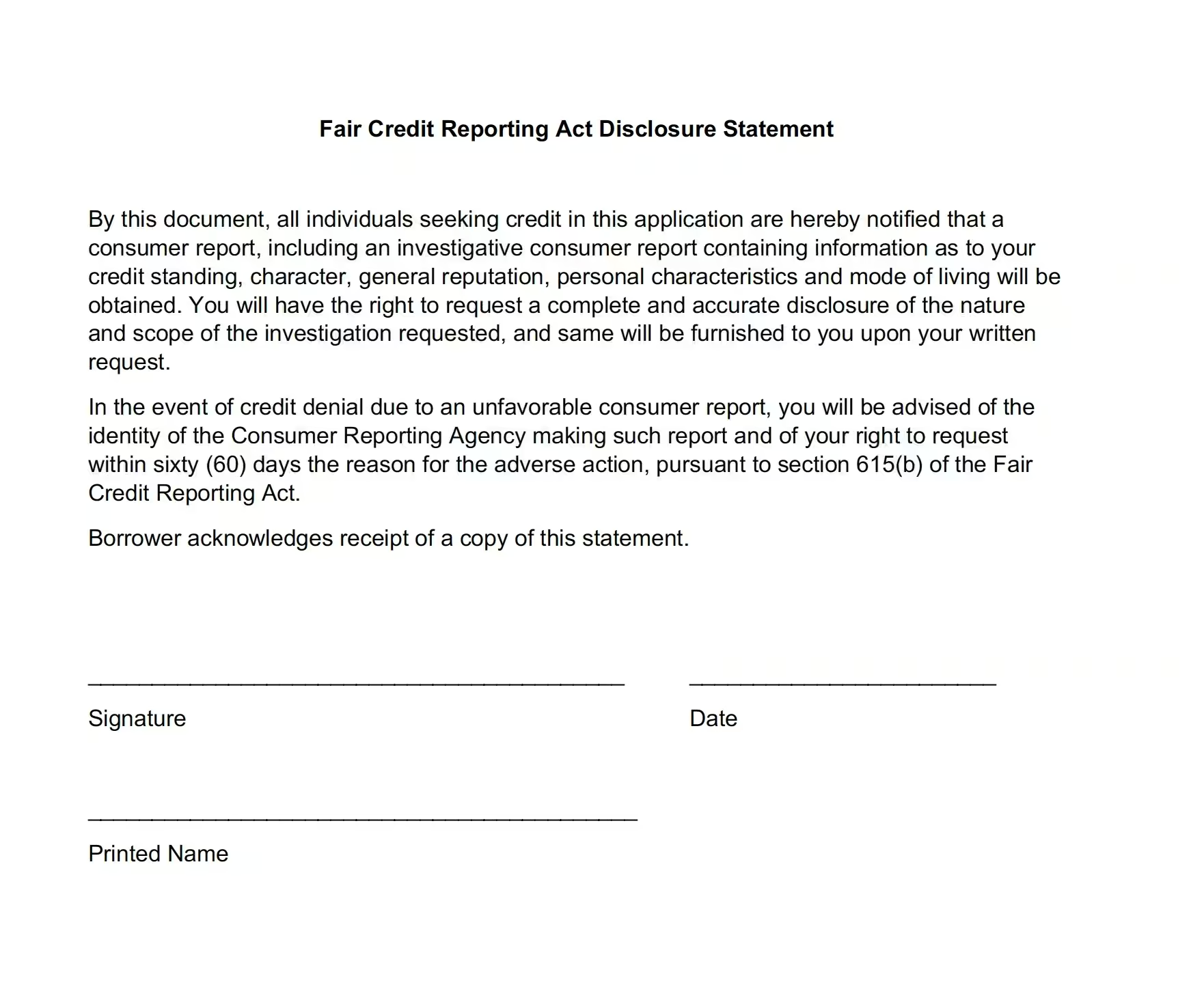
The Fair Credit Reporting Act governs when a consumer report may be obtained at all. For tenant screening the relevant permission is the “permissible purpose” rule at 15 U.S.C. § 1681b(a)(3)(F)(i) — a legitimate business need in connection with a business transaction initiated by the consumer. Written authorisation is how most landlords evidence that, and screening companies almost always require it by contract, but the strict standalone written disclosure people often quote is an employment rule rather than a rental one. The section below sets out what actually applies.

Ready to implement secure e-signatures and compliant tenant screening?
Order Comprehensive Tenant Reports with Built-in ConsentGet instant access to credit, criminal, eviction history, and more — all with proper electronic authorization.
The Growing Problem of Locked or Frozen Credit Files
Many applicants freeze their credit files for security, but forget (or intentionally neglect) to lift the freeze, blocking access even with signed consent.
Why Skipping Credit History Is a Major Risk for Landlords
Full credit history reveals payment patterns, debt levels, and financial responsibility — critical predictors of rental success.

What Does the FCRA Actually Require for Tenant Screening?
This is worth getting right, because the rule most often quoted at landlords is borrowed from a different context.
The employment rule is not the rental rule. 15 U.S.C. § 1681b(b)(2)(A) requires that “a clear and conspicuous disclosure has been made in writing to the consumer… in a document that consists solely of the disclosure, that a consumer report may be obtained for employment purposes.” That standalone-document requirement is strict, it is litigated frequently, and it sits inside a subsection headed Conditions for furnishing and using consumer reports for employment purposes. It governs employers. It does not, by its own terms, govern a landlord screening a rental applicant.
What governs a landlord is permissible purpose. Under § 1681b(a)(3)(F)(i) a consumer report may be furnished to someone who “otherwise has a legitimate business need for the information… in connection with a business transaction that is initiated by the consumer.” An applicant who submits a rental application has initiated that transaction. That is the federal basis on which a tenant screening report is lawfully obtained.
So why does everyone still collect a signature? Three practical reasons, none of which is the employment statute. Your screening provider requires it — consumer reporting agencies impose certification and authorisation obligations by contract, and will suspend an account that cannot produce consent. Several states impose their own written-consent or disclosure requirements on tenant screening, and those genuinely bind you. And a signed authorisation is the cleanest evidence that the transaction was consumer-initiated if the permissible purpose is ever questioned.
The practical upshot is unchanged — get written authorisation every time — but the reason matters. A landlord who believes the employment rule applies will often build the wrong form: a standalone single-purpose disclosure that omits the rental context, when what they actually need is a clear authorisation that establishes a consumer-initiated transaction and satisfies their provider and their state.
What Makes an Electronic Signature Legally Valid?
The federal answer is short and unusually clear. Under the Electronic Signatures in Global and National Commerce Act, 15 U.S.C. § 7001(a), a signature, contract or other record relating to a transaction in or affecting interstate commerce “may not be denied legal effect, validity, or enforceability solely because it is in electronic form” — and a contract may not be denied effect solely because an electronic signature or record was used in its formation.
Read that carefully: the Act does not make every electronic signature valid. It removes electronic-ness as a ground for invalidity. Everything else that would make a signature good or bad still applies — whether the person actually assented, whether they knew what they were signing, whether you can show it was them.
Where consumer disclosures are involved, § 7001(c) adds conditions. Where another law requires information to be given to a consumer in writing, an electronic record satisfies it only if the consumer affirmatively consents to receiving it electronically and has not withdrawn that consent; is given a clear statement of their right to a paper copy and to withdraw consent, and of any consequences of withdrawing; is told what hardware and software they need to access and retain the records; and gives that consent in a way that reasonably demonstrates they can actually access the records in the form they will be provided. If the technical requirements later change materially, the consumer has to be told and the consent process repeated.
State law sits on top. Most states have adopted a version of the Uniform Electronic Transactions Act, and some have their own additions and exceptions. The state layer varies, so a process that is comfortably valid in one state is worth re-checking if you operate across several.
What Should a Screening Authorization Contain?
A short, plain authorisation that a person can read in a minute is worth more than a dense one they scroll past. Eight elements do the work.
Who is asking. Your name or your company’s, and the property. An authorisation addressed to nobody in particular is hard to rely on later.
What is being obtained. Name the report types — credit, criminal history, eviction records, rental history, income or employment verification. “A background check” is too vague to be meaningful consent.
What it will be used for. Evaluating this application, for this property. Tying the authorisation to a specific tenancy is what stops it being read as an open-ended permission.
Who will run it. Naming the consumer reporting agency helps the applicant, and it is information they will need anyway if you later take adverse action.
The applicant’s identifying information — full legal name, current address, date of birth and, where you genuinely need it, Social Security number. Collect it in the form, not in a follow-up email.
An affirmative act of consent, not a pre-ticked box. The applicant should have to do something.
Signature and date. The date matters more than people expect: an authorisation from a previous application, months old, is not consent for today’s report.
The electronic-records consent required by § 7001(c) where you are delivering disclosures electronically — the right to a paper copy, the right to withdraw, and what is needed to open the documents.
Our tenant screening authorization form is built around these elements and can be signed electronically.
What Undermines an Authorization?
Four mistakes account for most unusable consent, and all four are easy to avoid once seen.
Burying the authorisation inside the application. A consent clause in paragraph nine of a six-page application, above a single signature that also covers the lease terms and a fee agreement, invites the argument that the applicant never knowingly consented to anything in particular. Keep the authorisation visually and structurally distinct, with its own heading and its own signature, even though the standalone-document rule itself is an employment requirement. The reason to separate it is evidentiary, not statutory.
Hidden waivers. Authorisations sometimes carry a clause releasing the landlord and the screening company from all liability arising from the report. Beyond how such clauses fare under state law, they change the character of the document: an applicant asked to sign away rights in order to be considered for housing is being asked for something quite different from permission to run a report. Ask for the permission, not the release.
Vague scope. “And any other information deemed relevant” is not scope. If you may pull an investigative report involving interviews about character or reputation, that is a materially different product with its own disclosure obligations, and it should be described rather than swept in.
Re-using an old authorisation. A signature from an application six months ago, for a different unit, is not consent for a new report. Set a validity window, state it on the form, and get a fresh signature outside it.
What Makes an E-Signature Defensible Later?
The question that decides a dispute is rarely “is an electronic signature valid?” It is “can you show this person signed this document?” That is an evidence question, and it is answered by the audit trail rather than by the statute.
Keep what the platform records. A usable trail shows the signer’s name and email, the timestamp, the IP address, the sequence of events from opening to signing, and a document hash or version identifier proving the signed document is the one you hold. Most reputable e-signature services produce a certificate containing exactly this — export and store it with the signed form rather than leaving it in the vendor account.
Bind the signature to the document, not just the session. A trail that proves someone clicked a button but cannot show which version they saw is worth much less than one that ties a signature to a specific document version.
Verify the signer to a reasonable degree. Sending the request to an email address the applicant supplied and confirmed — rather than one typed on their behalf — is the simplest useful step.
Keep the blank form too. If you revise your authorisation, retain the earlier versions. Being able to produce the exact wording in force on the day someone signed is often the whole answer.
Does Each Applicant Need Their Own Authorization?
Yes. Every person you run a report on is a separate consumer, and consent is personal to them — one signature at the bottom of a joint application does not authorise reports on everyone named above it.
That covers each adult occupant, each co-tenant, and any proposed co-signer or guarantor. A co-signer is often the one overlooked, because they feel like an attachment to someone else’s application rather than an applicant in their own right — but you are pulling their file, so you need their authorisation, and if their report contributes to a decline they are entitled to their own adverse action notice. Our co-signer agreement covers screening them properly.
Electronic signing makes this easier rather than harder: send each person their own request to their own verified email address, and the audit trail separates cleanly by signer instead of resolving to whoever happened to fill the form in.
Can an Applicant Refuse to Sign Electronically?
Yes — and handling that refusal badly is a bigger risk than the paperwork it saves.
Where you are relying on electronic delivery of disclosures, § 7001(c) is built around the consumer’s choice: consent must be affirmative, the consumer must be told of their right to obtain a paper copy and to withdraw consent, and they must be told of any consequences of withdrawing. An applicant who declines electronic records is exercising something the statute contemplates, not obstructing you.
Practically, keep a paper path open. An applicant may have no smartphone, may share a device, may have accessibility needs that your signing platform handles poorly, or may simply not want to create an account with a vendor they have never heard of. None of those says anything about whether they will pay rent.
Do not treat refusal as a negative screening signal. Declining an applicant, or deprioritising them, because they would not sign electronically risks disadvantaging older applicants and applicants with disabilities in particular — and the reason for the decision will be written down in your own process notes. Offer the paper alternative, apply the same criteria, and record that you did.
The practical form of this is a single line in your criteria: applications may be signed electronically or on paper, and the same information is required either way.
The Consent Workflow, Start to Finish
Most compliance problems are sequencing problems rather than document problems. This order works.
1. Publish your screening criteria before you take applications. What you require of every applicant — income, credit, rental history, criminal-history policy — written down and applied to everyone. Consent collected against undisclosed criteria still leaves you deciding without a standard.
2. Send the authorisation as its own step. Not appended to the lease, not implied by the application fee. The applicant should see a document that says what will be obtained and by whom.
3. Capture the electronic-records consent at the same moment if you are delivering disclosures electronically — the § 7001(c) items: paper copy on request, right to withdraw, what is needed to open the files.
4. Verify the email is the applicant’s before sending. A signature request forwarded through a letting agent or typed in on someone’s behalf weakens the trail at its foundation.
5. Run the report only after the signature lands, and only for the report types named on the form.
6. Store the signed form, the audit certificate and the result together, at the same time, in the applicant’s file. Records assembled later are records with gaps.
7. If the file is frozen, ask — do not decide. Give the applicant the bureau name and a deadline, and hold the application open.
8. If you decline, send the adverse action notice before you fill the unit, not after. The obligation attaches to the decision, not to the vacancy.
Applied consistently, this sequence also produces the thing that defends a fair-housing complaint: an identical, documented process for every applicant.
Investigative Consumer Reports Carry Extra Duties
If your screening goes beyond database records into interviews — calling neighbours, former landlords or associates about an applicant’s character, reputation or mode of living — you may have commissioned an investigative consumer report, and a separate part of the FCRA applies.
Under 15 U.S.C. § 1681d(a), such a report may not be procured unless it is clearly and accurately disclosed to the consumer that a report “including information as to his character, general reputation, personal characteristics, and mode of living” may be made, with that disclosure made in writing, mailed or otherwise delivered to the consumer not later than three days after the date on which the report was first requested. The disclosure must tell the consumer of their right to request more information and include the written summary of rights. You must also certify to the agency that you made the disclosure.
Section 1681d(b) then gives the consumer a right to ask: on a written request made within a reasonable period, you must give “a complete and accurate disclosure of the nature and scope of the investigation requested” within five days of receiving the request, or of when the report was first requested, whichever is later.
Most landlords never trigger this, because most tenant screening is database work. But a routine-sounding instruction to a provider — “can you speak to the previous landlords and get a sense of what they were like” — can cross the line, and the three-day clock starts at the request, not at the answer.
State Rules Change the Wording and the Timing
Federal law sets a floor. States build on it, and tenant screening is an area where they build a lot.
The variations that most often catch landlords out are application-fee caps and receipt requirements; limits on what criminal history may be considered and how far back; rules requiring the criteria to be disclosed before a fee is taken; requirements to give the applicant a copy of the report or to name the agency; and, in several jurisdictions, restrictions on when in the process a criminal-history question may be asked at all.
Some states also regulate electronic transactions in ways that add to the federal ESIGN position, and a few have consumer-reporting statutes of their own that sit alongside the FCRA rather than mirroring it.
The practical approach is to write your process against the strictest jurisdiction you operate in, or to maintain a genuine per-state variant — not to assume the federal minimum is the whole answer. Our tenant screening laws by state guide sets out where the differences fall.
What Should You Require of an E-Signature Tool?
The question is not which brand, it is what the tool has to produce. Five requirements cover it.
An exportable audit certificate containing signer identity, timestamps, IP address, the event sequence and a document hash — and exportable in a form you can keep outside the vendor’s system. If the evidence lives only in an account you might one day stop paying for, it is not really your evidence.
Document version binding, so the certificate proves which version of the authorisation was signed, not merely that a signature happened.
Support for the § 7001(c) consent flow — presenting the electronic-records disclosure, capturing affirmative consent, and recording it, rather than assuming it.
Retention and export you control. You should be able to pull every signed authorisation and its certificate in bulk, because that is what a provider audit or a dispute actually asks for.
Access control. These documents carry dates of birth and often Social Security numbers. Per-user access and a log of who opened what is the minimum for a file of that sensitivity.
Frozen and Locked Credit Files: How to Clear One
This is the most common way a properly authorised screening still fails, and the fix is faster than most landlords realise.
A security freeze blocks the report regardless of consent. A freeze restricts the consumer reporting agency from releasing the file, and no authorisation the applicant signs for you overrides it — the freeze is a standing instruction to the agency, not to you. So a returned “file frozen” result is not a compliance failure and not evasion; it usually means the applicant froze their credit after a breach notice and forgot.
The statutory timing is the useful part. Under 15 U.S.C. § 1681c-1, on a request made directly by the consumer with proper identification, an agency must remove a freeze within one hour where the request comes by toll-free telephone or secure electronic means, and within three business days where it comes by mail. Placement runs on a similar clock: one business day electronically or by phone, three business days by mail. In practice an applicant can lift a freeze from their phone while you are still speaking to them, and you can re-run the report the same afternoon.
Tell them which bureau. Freezes are placed with each agency separately, so an applicant may have frozen all three or only one. Naming the agency your provider uses turns a vague instruction into a two-minute task.
A lock is not a freeze. The credit bureaus also sell “lock” products, which behave similarly but are contractual services governed by that bureau’s own terms rather than by the statutory freeze regime and its timing rules. If an applicant says their credit is locked rather than frozen, they may need to use that bureau’s app, and the statutory one-hour rule is not what applies.
Ask before you decline. Treating a frozen file as a failed screening penalises a security-conscious applicant for a step consumer protection actively encourages. Ask for the freeze to be lifted, give a clear deadline, and apply that same policy to every applicant.
How Long Should You Keep the Signed Authorization?
Keep the signed authorisation, the audit trail and the report result together, for every applicant — including the ones you declined. Declined applications are the files most likely to be questioned later and the ones landlords most often fail to keep.
Retention periods for screening records are set by a mix of state law, your screening provider’s agreement, and the limitation periods that apply to the claims someone might bring, so there is no single national number. What is consistent is the principle: you should be able to produce, for any report you obtained, the authorisation that permitted it and the date it was signed.
Store them where access is limited. An authorisation carries a date of birth and often a Social Security number, and the same file usually holds the report itself. A shared drive that the whole office can browse is not a suitable home for it.
When the Report Comes Back: Adverse Action
Collecting consent well is only the first half. If you decline an applicant, or approve them on worse terms, based in whole or in part on what the report said, 15 U.S.C. § 1681m(a) requires you to give notice of the action; the name, address and telephone number of the consumer reporting agency that supplied the report; a statement that the agency did not make the decision and cannot give the reasons for it; and notice of the applicant’s right to a free copy of the report and to dispute what it contains.
Two points catch landlords out. A conditional approval — requiring a co-signer or a larger deposit because of the report — is itself adverse action. And where several people applied together, each person the report affected is entitled to their own notice. Our adverse action notice guide sets out the sequence, and the FCRA guide for landlords covers the wider obligations.
Conclusion: Embrace E-Signatures for Better Screening in 2026
Electronic signatures are essential for efficient, compliant tenant screening. Don’t let outdated processes or locked files cost you time and money.
Explore our free screening forms, income verification guide, and professional reports.


